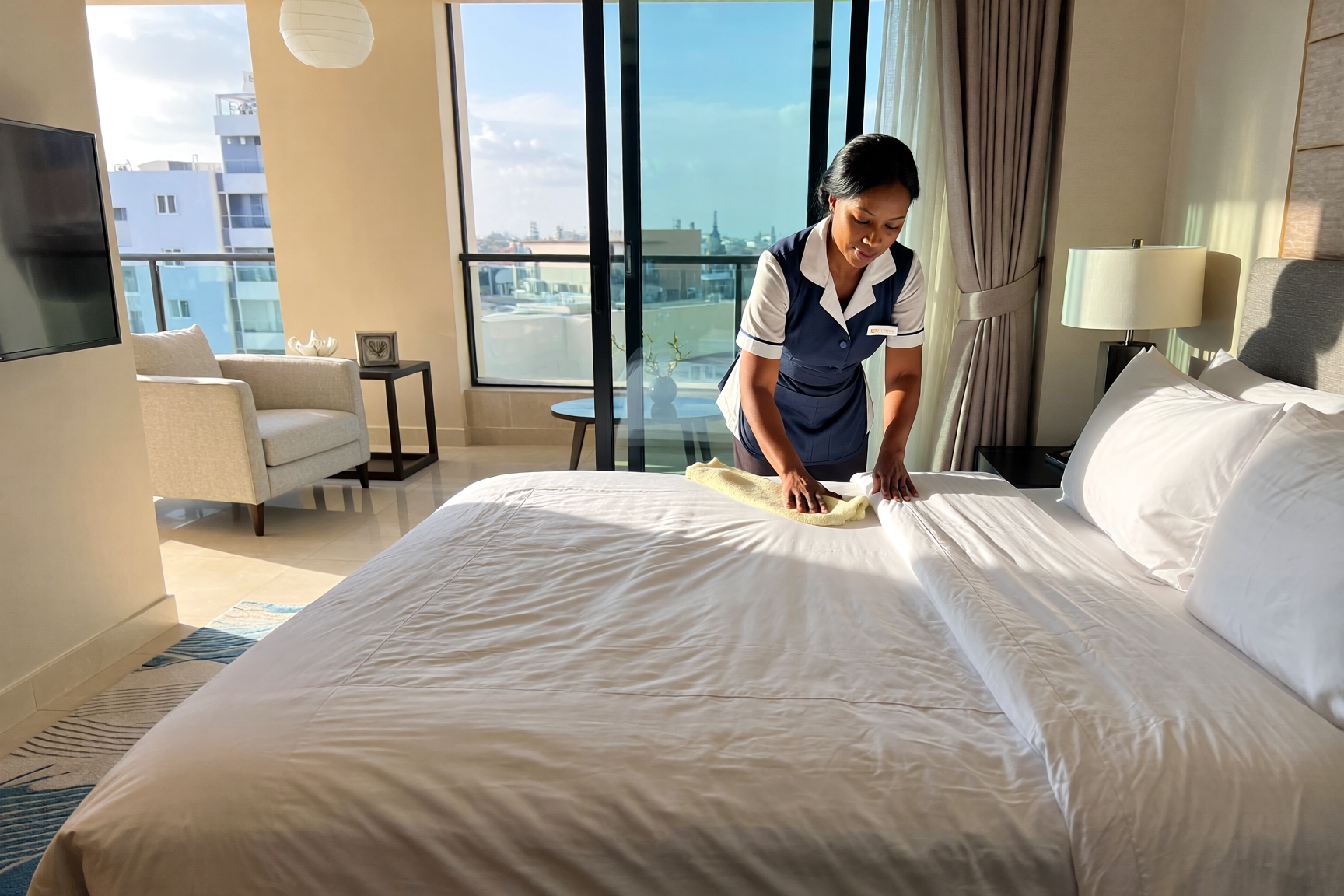
Welcome! If you've ever wondered what the fair housekeeper daily room cleaning amount should be, or how many rooms a cleaner can realistically tackle in a day, you're in exactly the right place. This article represents the conclusion of months of research into Nigeria's domestic work sector and years of experience covering labour issues across our country.
I've spent countless hours speaking with housekeepers in Lagos, Abuja, and Port Harcourt, comparing notes with hotel managers, and examining what actually works in Nigerian homes. What I've discovered might surprise you, particularly when it comes to fair compensation and realistic expectations.
The question of daily cleaning rates isn't just about money (though that's certainly important). It's about respect, professionalism, and understanding the genuine effort required to maintain clean, healthy living spaces.
Let's explore this together.
How Many Rooms Should a Housekeeper Clean Per Hour?
This is where expectations often clash with reality, rather like assuming you can drive from Lagos to Abuja in three hours without accounting for Nigerian roads!
A professional housekeeper can typically clean between two to four rooms per hour, depending on the room size and cleaning depth required. This assumes standard bedrooms or living areas, not industrial spaces or homes that haven't seen proper cleaning in months.
I remember visiting a friend's newly rented flat in Lekki where she complained her housekeeper was "too slow" because she only managed three bedrooms in an hour. When I looked closer, each "bedroom" was actually a master suite with attached bathroom, walk-in wardrobe, and balcony. The poor woman wasn't slow at all; she was thorough. That's the difference between rushing through spaces and actually cleaning them properly.
The Federal Ministry of Labour and Employment has established guidelines for domestic workers that emphasise fair working conditions. Whilst these don't specify exact room counts, they do stress reasonable workloads that allow workers to maintain quality standards without exhaustion.
For light cleaning (dusting, sweeping, basic tidying), a housekeeper might manage four rooms hourly. For deep cleaning (mopping, bathroom scrubbing, window washing, furniture polishing), expect two rooms per hour. Anything beyond that risks either poor quality work or worker burnout.
The room type matters enormously. A small guest bedroom might take 15 minutes, whilst a family bathroom with years of soap scum buildup could require 45 minutes of serious elbow grease.
Most Nigerian households expect daily or weekly cleaning rather than hotel-style hourly turnover. This changes the calculation entirely. Your housekeeper isn't racing against time like hotel staff; she's maintaining an already clean space or tackling accumulated mess. These require completely different approaches.
According to research from international cleaning standards, professional housekeepers in hotel settings manage approximately 15 rooms per eight-hour shift when following proper protocols. That's roughly two rooms per hour, which aligns perfectly with what domestic workers in Nigeria report as sustainable rates.
How Much Do Cleaners Charge Per Day in Nigeria?
Right, let's talk money. This is where things get interesting, and frankly, where many Nigerian employers get it spectacularly wrong.
Daily rates for housekeepers in Nigeria range from ₦3,000 to ₦15,000, depending on location, experience, scope of work, and whether the cleaner provides their own supplies. That's quite a spread, I know, but let me break down why these variations exist.
In Lagos, particularly areas like Ikoyi, Victoria Island, and Lekki, daily rates typically start at ₦5,000 and can reach ₦15,000 for experienced professionals handling large properties. I've seen families pay ₦20,000 daily for specialised deep cleaning of five-bedroom homes with multiple bathrooms.
Abuja rates sit slightly lower, usually ₦4,000 to ₦12,000 daily. Port Harcourt, Ibadan, and other major cities hover around ₦3,000 to ₦8,000. Smaller towns might see ₦2,000 to ₦5,000, though finding professional housekeepers in these areas can prove challenging.
Here's something I've noticed from covering domestic worker issues extensively: families who pay below ₦3,000 daily often complain about poor quality work or theft. You get what you pay for. If you're paying someone ₦2,500 to clean a four-bedroom house, you're essentially saying their labour is worth less than a decent meal at a Lagos restaurant. That creates resentment, not loyalty.
The National Salaries, Incomes and Wages Commission has worked to establish minimum wage standards across Nigeria, currently set at ₦70,000 monthly for formal employment. Whilst domestic workers often fall outside formal employment structures, this provides a baseline for understanding fair compensation. A housekeeper working five days weekly should reasonably earn comparable amounts when daily rates are calculated monthly.
Live-in housekeepers typically earn ₦30,000 to ₦80,000 monthly, plus accommodation and food. This works out differently from daily rates because you're essentially covering their living expenses plus salary. Don't make the mistake of thinking free accommodation equals half the salary. It doesn't.
Transportation costs significantly impact daily rates. If your housekeeper spends ₦1,500 on transport to reach your home, a ₦3,000 daily rate leaves them with ₦1,500 for eight hours of physically demanding work. That's roughly ₦190 hourly, well below minimum wage standards when calculated properly.
Professional cleaning companies charge ₦10,000 to ₦50,000 per visit depending on property size and services required. These companies handle taxes, insurance, and supply costs, which individual housekeepers cannot. The higher rates reflect these professional overheads.
I've learned that fair payment creates better outcomes for everyone. Your housekeeper arrives motivated, works thoroughly, and becomes invested in maintaining your home to high standards. Underpayment creates exactly the opposite situation.
What Is the Daily 6 Cleaning List?
Ah, the daily cleaning routine! This is where many Nigerian households struggle because they either expect too much or don't provide clear direction. The daily six cleaning list provides a practical framework that balances thoroughness with sustainability.
Here's how it typically breaks down:
This list represents what a housekeeper can realistically accomplish daily in a three to four-bedroom home over six to eight hours. Notice I said "daily" not "hourly." These tasks compound when done regularly but become overwhelming if left to pile up.
I remember speaking with a housekeeper named Blessing who works in Surulere. She told me her employer created a ridiculous daily list that included deep-cleaning the entire house, hand-washing all clothes (despite owning a washing machine), cooking three meals, and ironing everything including bed sheets. Blessing lasted three weeks before walking out. The employer then complained that "good help is impossible to find." The problem wasn't the help; it was the completely unrealistic expectations.
The daily six list assumes maintenance cleaning, not deep cleaning. Deep cleaning tasks like washing windows, scrubbing walls, cleaning ceiling fans, or reorganising cupboards should happen weekly or monthly, not daily. Mixing these categories creates unreasonable workloads.
Your daily cleaning schedule should account for property size, number of occupants, and whether anyone is home during cleaning hours. A home with six people, three dogs, and constant cooking requires more intensive daily cleaning than a two-person household where everyone works outside the home.
Cultural considerations matter here too. Nigerian households often maintain higher cleanliness standards than Western homes, partly due to our dusty environment requiring more frequent mopping and partly because we tend to remove shoes indoors and sit on floors more commonly. This means our "daily" cleaning might be someone else's "deep" cleaning.
The daily six shouldn't feel like a military operation. It's a gentle rhythm of maintaining cleanliness rather than constantly battling chaos. When done consistently, each task takes less time because things never get desperately dirty.
One thing I've noticed: households that provide proper cleaning supplies experience better results. Don't expect your housekeeper to achieve sparkling results with a single worn-out rag and diluted detergent. Invest in proper mops, quality cleaning products, good gloves, and appropriate tools. This isn't luxury; it's basic professionalism.
Seven Steps to Determine Fair Housekeeper Compensation
After years of researching domestic employment in Nigeria, I've developed a systematic approach for calculating appropriate housekeeper compensation. This method considers Nigerian economic realities whilst ensuring fair treatment for workers who keep our homes running smoothly.
Step 1: Calculate Your Property's Cleaning Requirements
Start by honestly assessing your space. Count bedrooms, bathrooms, living areas, and special features like balconies, boys' quarters, or compound areas. A three-bedroom flat in a high-rise requires different effort than a three-bedroom detached house with garden and garage.
Measure your total living space if possible. Properties under 100 square metres need less time than those exceeding 200 square metres. Be realistic here. I've met families claiming they have a "small" home when they actually live in 250-square-metre properties. That's not small; that's substantial.
Step 2: Assess Cleaning Frequency and Depth
Daily cleaning requires less intensive work per visit but more consistent presence. Weekly cleaning involves deeper tasks each session. Monthly deep cleaning should cost considerably more because it addresses accumulated grime and neglected areas.
If you're home during cleaning hours, work flows differently than when the housekeeper has the property to themselves. Children and pets multiply cleaning requirements significantly. Factor these realities into your expectations and budget.
Step 3: Research Local Market Rates
Ask neighbours, check local Facebook groups, or speak with domestic worker agencies about going rates in your specific area. Lagos-Mainland rates differ from Lekki rates, which differ from Ikorodu rates. Location matters.
Don't just ask what people pay; ask what they should pay for quality work. Many Nigerians underpay domestic workers, so average rates often reflect exploitation rather than fair compensation.
Step 4: Factor in Transport and Supply Costs
Calculate realistic transport costs from your housekeeper's residence to your home. In Lagos, this easily runs ₦1,000 to ₦3,000 daily depending on distance and traffic patterns. Your housekeeper shouldn't spend 40% of their salary just reaching your door.
Decide whether you'll provide cleaning supplies or expect them to bring their own. If the latter, add ₦500 to ₦1,500 to the daily rate to cover these costs. Quality cleaning products aren't cheap, and expecting workers to fund supplies from already minimal wages is fundamentally unfair.
Step 5: Apply the Minimum Wage Test
According to the Federal Ministry of Information and National Orientation, Nigeria's current minimum wage stands at ₦70,000 monthly. Divide this by 22 working days (accounting for Sundays) to get ₦3,182 as the absolute minimum daily rate.
However, this represents the legal floor, not fair compensation for skilled labour. Experienced housekeepers deserve substantially more, typically ₦5,000 to ₦8,000 daily in major cities. Specialised skills like deep carpet cleaning, window washing, or professional organisation command premium rates.
Step 6: Consider Experience and References
A housekeeper with ten years of experience and solid references deserves more than someone just starting out. This isn't snobbery; it's recognising that experienced workers complete tasks faster, handle problems independently, and maintain higher standards without constant supervision.
Personally, I'd rather pay ₦8,000 for someone who arrives on time, works efficiently, and treats my belongings respectfully than ₦3,000 for someone unreliable. The ₦5,000 difference saves me countless headaches and replacement costs for broken items.
Step 7: Build in Annual Increases
Inflation affects domestic workers just like everyone else. If you're paying ₦5,000 daily this year, that same amount next year represents a pay cut in real terms. Plan for 10-15% annual increases to maintain fair compensation relative to rising living costs.
Also factor in bonuses for excellent work, especially around Christmas or during Ramadan. A ₦10,000 to ₦20,000 annual bonus shows appreciation and builds loyalty. Compare this to constantly replacing unreliable workers, retraining newcomers, and dealing with theft from resentful underpaid staff.
Standard Room Cleaning Rates Across Nigerian Cities
Based on extensive market research and interviews with domestic workers across Nigeria's major urban centres, here's what you can realistically expect to pay for professional housekeeping services. These rates reflect 2026 market conditions and account for inflation, transport costs, and regional economic variations.
These figures reveal significant regional variations driven by cost of living differences, labour market competition, and local economic conditions. Lagos Island commands premium rates because everything costs more there, from transport to basic foodstuffs. A housekeeper earning ₦8,000 daily in Surulere enjoys better purchasing power than one earning ₦10,000 in Victoria Island once transport and living costs are factored in.
The "rooms per day" column assumes standard-sized rooms with maintenance cleaning, not deep cleaning or rooms that haven't been touched in weeks. Hotel housekeepers manage similar numbers, but they're working with standardised rooms and industrial equipment, rather than diverse Nigerian home layouts and varying supply quality.
How Much to Pay a Cleaner for 3 Hours in Nigeria?
Three-hour cleaning sessions represent a popular option for smaller properties or supplementary cleaning between regular deep-clean days. This arrangement works brilliantly for one to two-bedroom flats, quick maintenance cleans, or focused tasks like kitchen deep-cleaning or bathroom scrubbing.
For three hours of professional cleaning in Nigeria, expect to pay ₦2,500 to ₦6,000 depending on your location and the work scope. Lagos rates typically start at ₦3,500 for three hours, whilst smaller cities might charge ₦2,000 to ₦3,000. These rates assume the cleaner brings basic supplies; add ₦500 to ₦800 if you want them to provide all cleaning products.
I've found that three-hour arrangements work best when you're very specific about priorities. You can't expect someone to deep-clean an entire three-bedroom house in three hours. That's fantasy thinking. Instead, focus on high-priority areas: kitchen and bathrooms one session, bedrooms and living areas the next.
A realistic three-hour session might cover thorough kitchen cleaning (including inside the fridge and oven), two bathrooms, and general tidying of living spaces. Alternatively, concentrate on bedroom deep-cleaning, including changing linens, dusting all surfaces, cleaning windows, and mopping floors. Choose your battles.
Professional cleaning companies often prefer minimum four-hour bookings because shorter sessions don't justify transport time and setup. Individual housekeepers prove more flexible with three-hour arrangements, particularly for regular weekly clients. A housekeeper who visits you every Wednesday for three hours develops efficient routines that maximise productivity.
Payment structure matters here. Some cleaners charge hourly (₦800 to ₦2,000 per hour depending on location and experience), whilst others prefer flat rates for specific tasks regardless of time taken. Experienced cleaners often finish faster, which makes task-based pricing fairer than strict hourly rates.
Transport costs significantly impact three-hour arrangements. If your housekeeper spends ₦1,500 reaching your home for a ₦2,500 three-hour session, they're essentially working for ₦330 hourly after transport. That's exploitation, not employment. Either increase the rate or arrange for longer sessions that justify travel costs.
I remember speaking with a cleaner named Patricia in Ajah who told me she stopped accepting three-hour bookings because the economics didn't work. Between transport (₦2,000 round trip), time lost travelling (90 minutes each way), and the actual work (three hours), she was better off taking one five-hour job closer to home. This is why many professional cleaners set minimum rates regardless of hours worked.
The maths changes if your cleaner lives nearby. Someone walking 10 minutes to your flat can reasonably accept three-hour bookings at lower rates because they're not losing time and money on Lagos traffic. Location, location, location matters in domestic work just like property sales!
Consider providing lunch if the three-hour session falls over mealtime. This needn't be elaborate but offering rice and stew or jollof demonstrates basic courtesy and humanity. I've noticed workers perform better when they feel respected and cared for, rather than treated as service machines.
Understanding Fair Compensation for Daily Housekeeping in Nigeria
After everything we've discussed, let me address the heart of this issue: what fair housekeeper daily room cleaning amount actually means in Nigerian context.
Fair compensation isn't just about meeting minimum wage requirements (though that's essential). It's about recognising that housekeeping is skilled labour requiring physical stamina, attention to detail, trustworthiness, and professional judgement. Someone maintaining your home deserves respect reflected in their pay packet.
The economic pressure facing Nigerian families makes labour costs feel burdensome, I understand completely. However, this doesn't justify underpaying workers who keep your home functioning. We must find balance between household budgets and worker dignity.
Consider what housekeepers actually do. They enter your private space, handle your belongings, clean your bathrooms (including dealing with things I won't detail here!), manage your laundry, and maintain the environment where you raise your children. This requires trust, skill, and considerable physical effort. Yet many Nigerian families pay their housekeepers less than they spend on weekend outings or monthly DSTV subscriptions.
The care economy sector contributes significantly to Nigeria's productivity by enabling professionals to work whilst knowing their homes are properly maintained. Investing in fair wages for domestic workers isn't charity; it's recognising their essential economic contribution.
I've observed that families paying fair wages experience better outcomes across the board. Workers arrive reliably, take pride in their work, stay in positions for years rather than months, and develop genuine care for the families they serve. This stability benefits children especially, who form relationships with consistent caregivers rather than a revolving door of resentful strangers.
From a purely practical standpoint, fair pay reduces theft. Workers earning living wages don't need to steal to survive. This isn't universal (some people steal regardless), but systematic underpayment creates predictable problems. Pay someone ₦40,000 monthly to clean a mansion whilst knowing a single designer handbag in the wardrobe costs ₦500,000, and you're practically inviting temptation.
Quality cleaning requires proper supplies: good mops, effective disinfectants, appropriate brushes, protective gloves, and reliable equipment. If you're providing these, great. If you expect workers to supply everything themselves whilst paying minimal wages, don't be surprised by poor results.
Transparency helps everyone. Clearly outline what you expect, what you'll provide, and what compensation you offer. Put this in writing, even informally. Misunderstandings about expectations create most domestic employment conflicts I've witnessed over the years.
Remember that your housekeeper has expenses too: rent, food, healthcare, children's school fees, and yes, occasionally some small pleasures that make life worth living. A daily rate that barely covers transport and lunch whilst expecting eight hours of intensive labour isn't sustainable for anyone long-term.
The goal isn't to overpay to the point of creating dependency or unrealistic expectations. It's finding that sweet spot where workers feel fairly compensated for their effort whilst employers get genuine value for money. This typically means paying above minimum wage but below rates that would strain your household budget unsustainably.
Think about annual costs holistically. Paying ₦6,000 daily for five days weekly totals ₦120,000 monthly or ₦1,440,000 annually. That sounds substantial until you calculate what professional cleaning companies would charge for equivalent service (usually ₦50,000 to ₦100,000 monthly for regular comprehensive cleaning). Individual housekeepers typically cost less than agencies whilst providing more personalised, consistent service.
Related Articles on Nigerian Domestic Work and Fair Compensation
If you've found this examination of housekeeping compensation insightful, you might also appreciate exploring other aspects of Nigerian domestic work that shape household management and worker welfare. Our investigation into What Is Life Like in Nigeria Today provides broader context on living costs and economic pressures affecting both employers and workers in current Nigerian society. Additionally, our detailed analysis of What Is Nigeria's Quality of Life explores how domestic work arrangements reflect and influence overall standards of living across different regions and socioeconomic groups.
Conclusion: Finding Balance in Housekeeper Compensation
We've covered considerable ground exploring what fair housekeeper daily room cleaning amounts look like across Nigeria's diverse economic landscape. Let me draw these threads together.
Fair compensation for housekeepers benefits everyone involved. Workers who feel respected and fairly paid deliver better service, stay in positions longer, and develop genuine investment in maintaining high standards. Employers who pay reasonable rates avoid the endless cycle of recruitment, training, and dealing with poor-quality work or theft from resentful underpaid staff.
The key lies in understanding regional variations, recognising skilled labour when you see it, and building realistic expectations about what housekeepers can accomplish daily. A three-bedroom home requires different resources than a five-bedroom property. Lagos costs differ from Kano costs. Daily maintenance cleaning demands different preparation than monthly deep-cleaning sessions.
Nigerian economic realities make household budgeting challenging, but this doesn't justify exploitation of vulnerable workers. The domestic work sector enables countless Nigerian professionals to pursue careers whilst maintaining clean, organised homes. These workers deserve recognition through fair compensation.
Moving forward, I encourage you to approach housekeeper compensation with both generosity and wisdom. Research local rates thoroughly, factor in all costs honestly, and remember that the cheapest option rarely proves the best value long-term. Investing in fair wages creates stability that benefits your entire household.
Three Key Takeaways for Fair Housekeeper Compensation:
* Calculate total costs honestly: Factor in transport (₦500-₦3,000 daily), supplies (₦300-₦1,000), property size, and regional variations when setting rates. Fair compensation in Lagos Island (₦6,000-₦15,000 daily) differs substantially from smaller cities (₦2,500-₦6,000 daily), reflecting genuine cost-of-living differences.
* Match expectations to reality: Professional housekeepers clean 2-4 rooms hourly for maintenance work, or 8-14 rooms during full-day sessions. Expecting someone to deep-clean a five-bedroom house in three hours whilst also preparing meals and doing laundry represents fantasy thinking that creates resentment and poor outcomes.
* Build sustainable relationships through fair treatment: Annual increases (10-15%), occasional bonuses (₦10,000-₦20,000 yearly), proper supplies, and respectful communication transform domestic employment from exploitative drudgery into dignified work that benefits both employers and workers long-term.
Frequently Asked Questions About Housekeeper Daily Room Cleaning Amount
What Is Considered a Fair Daily Rate for Housekeepers in Lagos?
Fair daily rates for Lagos housekeepers range from ₦6,000 to ₦15,000 depending on location (Island vs Mainland), experience level, and scope of work. Basic cleaning in Lagos Mainland typically costs ₦4,000-₦7,000 daily, whilst Lekki or Victoria Island properties command ₦8,000-₦15,000 daily for experienced professionals managing large homes with multiple bathrooms and special cleaning requirements.
How Many Rooms Can One Housekeeper Realistically Clean in 8 Hours?
An experienced housekeeper can thoroughly clean between 8 to 14 standard rooms during an eight-hour workday, assuming maintenance cleaning rather than deep cleaning. This translates to roughly two to three rooms per hour when including bathrooms, which require significantly more time than bedrooms or living areas due to intensive scrubbing requirements.
Should I Provide Cleaning Supplies or Expect My Housekeeper to Bring Their Own?
Most Nigerian employers provide cleaning supplies including mops, buckets, detergents, disinfectants, and protective gloves as these are tools of the trade. If you expect housekeepers to provide their own supplies, add ₦500 to ₦1,500 to daily rates to cover these costs, as quality cleaning products represent significant expenses that shouldn't be borne by workers earning minimal wages.
What Tasks Should Be Included in Daily Cleaning Versus Weekly Deep Cleaning?
Daily cleaning covers kitchen surfaces, bathroom maintenance, bedroom tidying, sweeping and mopping floors, and basic organisation, whilst weekly deep cleaning addresses window washing, ceiling fan dusting, wall scrubbing, cupboard reorganisation, and thorough appliance cleaning. Mixing these categories creates unrealistic daily workloads that exhaust workers without improving overall home cleanliness.
How Much Should I Pay for Three Hours of Cleaning Work?
Three-hour cleaning sessions typically cost ₦2,500 to ₦6,000 depending on location, with Lagos averaging ₦3,500-₦5,000 and smaller cities charging ₦2,000-₦3,500. However, factor in transport costs honestly because if your cleaner spends ₦1,500 travelling for a ₦2,500 session, they're essentially working for ₦330 hourly, which represents exploitation rather than fair employment.
Do Live-In Housekeepers Cost Less Than Daily Housekeepers?
Live-in housekeepers earn ₦30,000 to ₦80,000 monthly plus accommodation and food, which calculates differently from daily rates because you're covering living expenses. Don't assume free accommodation equals half the salary, as dedicated workers deserve fair compensation regardless of living arrangements, particularly given they're available beyond standard working hours.
What Are Standard Working Hours for Daily Housekeepers in Nigeria?
Standard daily housekeeping shifts run six to eight hours, typically from 8:00 AM to 2:00 PM or 9:00 AM to 5:00 PM depending on household preferences and property size. Anything beyond eight hours should be compensated as overtime at 1.5 times the normal hourly rate, following basic labour fairness principles even though domestic workers often fall outside formal employment regulations.
Should I Pay Extra for Housekeepers Who Cook Meals?
Housekeepers who also prepare meals should receive additional compensation of ₦1,000 to ₦3,000 daily because cooking represents separate skilled labour beyond cleaning duties. This is particularly true if meal preparation involves market shopping, menu planning, or cooking for large families, as these tasks require different expertise and consume significant time.
How Often Should I Increase My Housekeeper's Daily Rate?
Annual increases of 10-15% help maintain fair compensation relative to Nigeria's inflation rate, which consistently affects domestic workers' purchasing power. Additionally, consider occasional bonuses around Christmas or Ramadan (₦10,000-₦20,000 annually) to show appreciation for excellent work, as these small investments build loyalty and prevent constant staff turnover that disrupts household stability.
What Is Minimum Wage for Domestic Workers in Nigeria?
Nigeria's current national minimum wage stands at ₦70,000 monthly, which translates to approximately ₦3,182 daily when calculated over 22 working days. However, this represents the legal floor rather than fair compensation for skilled labour, with experienced housekeepers in major cities reasonably commanding ₦5,000 to ₦8,000 daily based on expertise, reliability, and market conditions.
Should Transport Costs Be Included in the Daily Rate or Paid Separately?
Transport costs should either be paid separately (₦500-₦3,000 daily depending on distance) or factored into the daily rate when calculating fair compensation. Many Nigerian employers make the mistake of setting rates without considering that housekeepers spending ₦1,500 on transport from a ₦3,500 salary are left with just ₦2,000 for eight hours of physically demanding work.
How Do I Know If I'm Paying Fair Rates for My Area?
Research local market rates through neighbourhood groups, domestic worker agencies, or discussions with other employers in your area, but seek information about what employers should pay rather than what they actually pay, since many Nigerians systematically underpay domestic workers. Additionally, observe whether your housekeeper seems motivated and content versus stressed or resentful, as worker satisfaction often reflects compensation fairness better than abstract comparisons.